Enter Uganda, and revellers are welcomed by the awe-inspiring sculptures of mountain gorillas at the airport, the first glimpse into the natural diversity of Uganda. Along the highways stretching toward the equator, statues of elephants, lions, and hippos appear at intervals, celebrating the country’s rich and diverse wildlife. In this land that Winston Churchill, on his first visit, called the Pearl of Africa, beauty roams freely. Yet not all wonders receive the attention they deserve.
One such undercelebrated marvel is the ancient breed known as the Ankole long-horned cattle, cherished by the Banyankore cattle-keeping people of western Uganda.
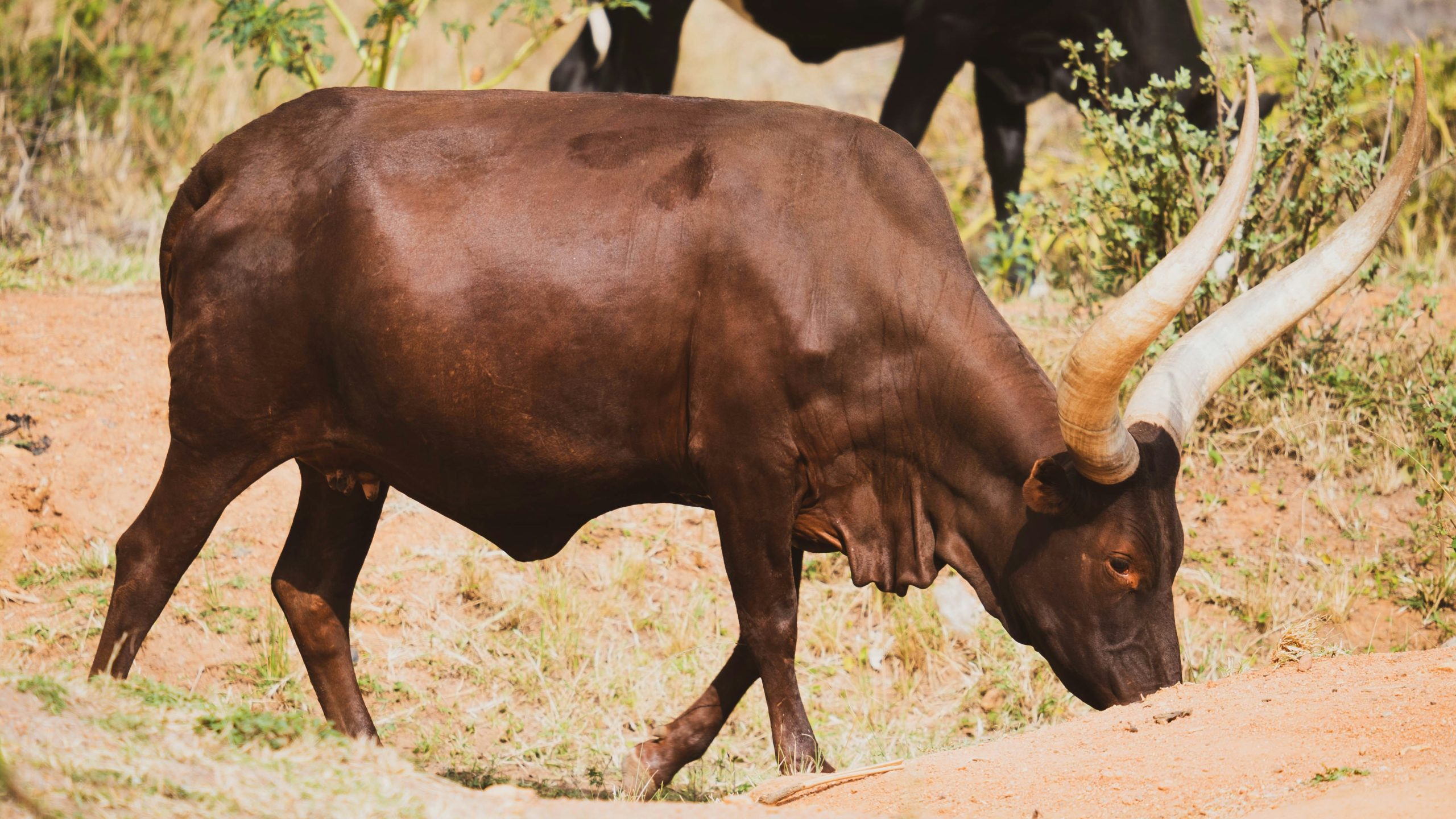
The Ankole long-horned cattle, known in Rwanda as Inyambo, a term borrowed from the Banyambo of Karagwe, Tanzania, are among the most majestic animals ever bred on the African continent. With massive, elegantly curved, bright white horns that can stretch over two meters, they are more than livestock. They are living symbols of prestige, tradition, and identity among the pastoralist community of the Bahima of western Uganda. Resilient in the face of drought and disease, they produce rich, high-fat milk and are deeply embedded in rituals, poetry, and the social fabric of their keepers.
Most visitors who arrive at Lake Mburo National Park come for the safari experience: the quiet, lush green grasslands overlooking the calm waters of
the lake, and the tall rocks that tower over the low-lying plains, ideal for game viewing and camping. But few know that this landscape is more than picturesque, it is ancestral. Lake Mburo lies in what was once the heart of the Nkore Kingdom, the homeland of the Bahima and their sacred cattle.
Here, every name of hills, valleys, rocks, and birds resonates with the Bahima culture. The animals that roam these lands, the colours of the cows, the shape of the rolling terrain itself, all carry echoes of a people who lived in harmony with nature, guided by rhythms of pasture and rain, of milk and songs.
Yet this way of seeing and celebrating beauty, through cattle, colour, sound, and spirit, is often lost on the visitors who cross oceans to marvel at our wilderness and our diverse culture.
The Ankole cattle come in a range of stunning hues: ivory, charcoal, bronze, and deep russet. In the Great Lakes region, especially in the kingdoms west of Buganda, precolonial kings kept herds of specific colours as emblems of royal power. These cattle were not just wealth; they were central to rituals, statecraft, and the political legitimacy of kings. It was and is still believed by the Bahima people that the mythical Bachwezi left these cattle behind, and that the spirits of these gods still live within them.
Archaeological evidence now supports what oral tradition has always known: the breed we call Ankole cattle, and Inyambo in Rwanda, has existed here for centuries.
Over generations, the Bahima cultivated an entire worldview around these animals. Through careful breeding, they created subtle variations of the
same breed, with patterns and horn shapes as distinct and expressive as fingerprints. Just as the pyramids of Egypt evoke awe, or the Grand Canyon stirs wonder, so too do the hundred white horns of an Ankole herd backlit by a savannah sunset.
But this heritage is facing serious threats.
Modernisation, globalisation, land pressure, and the relentless commercialisation of life have made it harder to sustain the old ways. Ankole cattle, though beautiful and spiritually resonant, are not known for high milk yields. In today’s cash-driven economy, many Bahima herders are turning to crossbreeds that offer greater productivity.
In 2018, we watched in shock as Ankole cattle transported to South Africa by President Cyril Ramaphosa fetched premium prices at auction, while their original breeders in Uganda had long overlooked their economic and cultural potential. The very animals that symbolise the Nkore nation’s soul and are integral to a group of people native to Uganda had become exotic luxury items elsewhere.
But it’s not too late. I believe we can turn around and make Ankole cattle a key part of our conservation efforts.
Imagine a cattle trail experience, walking at dawn beside a herdsman who calls each cow by name, names passed down through generations. Picture a cultural camp where travellers learn to smoke and perfume milk gourds, or listen to chants of praise once reserved for royal kraals of Omugabe. Think of photo safaris not for lions, but for these horned silhouettes glowing in the light of Ankole’s evening sun.
We have a rare opportunity: to protect and promote a breed not only for their utility, but for our soul and belonging.
Other countries have done it. In Spain, tourists gather to watch Andalusian horses dance. In India, the sacred cow is an emblem of national pride.
Why not Uganda’s Ankole?
Let us tell the world that in Nshaara, in Nyabushozi, in Kiruhura, where Lake Mburo National Park is situated, and beyond, a living legend still walks. Let us build homesteads where guests can sleep among the kraals, milk at sunrise, and hear the stories of how a people once followed the rhythm of hooves, and bells in cows’ necks and legs.
Let us protect not only the breed, but the worldview it represents—slow, graceful, generous, and proud.
Before the last white horn is melted down, before the final calf is sold to history, let us act.
You will learn how we name each cow not just for function, but for love, their markings and horn shapes inspiring poetry (Okwevuga and Okugamba Ente) and pride. The bond between the Bahima and their cattle is intimate. Our children learn to identify each cow by colour and call before they even learn their letters. Our songs celebrate their courage, their gentleness, and their beauty.
Step into a traditional Bahima homestead, where a circular kraal surrounds the home of the family head. Here, you will witness the art of ghee-making, a slow, sacred process that transforms milk into ghee. Women, adorned
with intricate beadwork on their foreheads, recount how brides were once fattened with milk, a key custom of marriage among the Bahima. You might sip yoghurt fresh from the calabash, or taste fresh milk in a smoked milk pot.
As the sun sinks low and the herd comes closer to home, join in ekyitaguriro, the traditional Banyankole dance. Men and women move together, their feet tracing the steps of generations, their voices rising in competitive verse, reciting praises of cattle and courage, and ancient wars.