
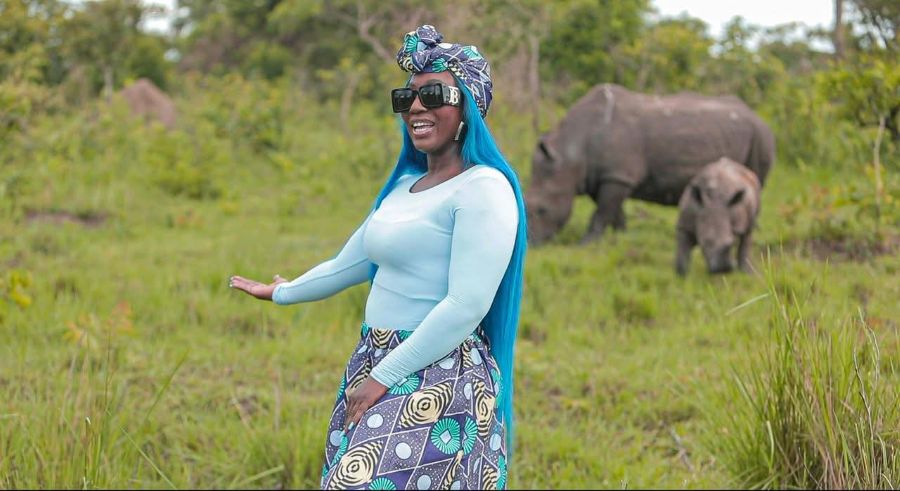
The recent visit of Spice to Uganda is more than a celebrity travel moment. It reflects a broader shift in how destinations are now discovered, experienced, and remembered in the global tourism economy.
Her journey through Namugongo Martyrs Shrine, cultural engagement with the Buganda Kingdom, wildlife encounters at Ziwa Rhino Sanctuary, and the dramatic landscape of Murchison Falls National Park did not function as isolated stops. Together, they formed a continuous narrative that travelled far beyond Uganda’s borders in real time.
This is where tourism marketing is fundamentally changing.
From promotion to lived storytelling.
Traditional tourism marketing has long relied on structured messaging, brochures, campaigns, and official narratives designed to “explain” destinations to potential visitors. That model is steadily giving way to something more powerful: lived storytelling.
Today, people are less influenced by what destinations say about themselves and more influenced by what others experience and share. Tourism is increasingly being consumed as emotion, not information.
A celebrity or influencer no longer just visits a destination. They translate it into a story that audiences can feel. In the case of Spice’s Uganda journey, Namugongo becomes more than a heritage site, Buganda becomes more than a kingdom, and Murchison Falls becomes more than a landscape. Each place becomes part of a narrative arc that communicates identity, emotion, and discovery.
Influencers as modern tourism infrastructure.
Influencer and celebrity travel now sits at the center of destination visibility. Musicians in particular occupy a unique space because they are already cultural carriers. Their influence extends beyond entertainment into aspiration, identity, and lifestyle.
When such figures move through destinations, they generate something traditional campaigns struggle to achieve: emotional proximity. Audiences do not just observe; they imagine themselves within the experience.
This is why influencer-driven tourism is no longer a supporting tool. It is becoming part of the infrastructure of how destinations are known globally.
Uganda as a naturally narrative-rich destination.
Uganda’s strength in this evolving landscape lies in its inherent diversity of experience. The combination of spiritual heritage, royal culture, conservation spaces, and dramatic natural beauty creates a layered tourism identity that is naturally cinematic.
The challenge is not the absence of product, but the absence of structured storytelling at scale. Experiences often exist in isolation rather than as connected journeys that build emotional continuity for visitors.
What Spice’s itinerary unintentionally highlights is that Uganda is already a multi-genre destination. It carries spirituality, culture, wildlife, adventure, and community life within a single geography. That combination is exactly what modern travelers are increasingly seeking.
The emergence of story-based itineraries.
One of the most important shifts in tourism development globally is the move from itinerary-based planning to story-based design. Travelers are no longer just moving between locations; they are moving through experiences that feel emotionally connected.
In this context, Uganda has the opportunity to design journeys that behave like narratives rather than schedules. A visit to Namugongo can set a spiritual tone, Buganda can deepen cultural understanding, Ziwa can introduce conservation awareness, and Murchison Falls can serve as a visual and emotional climax.
When structured intentionally, such journeys become more than travel routes. They become experiences that are naturally shareable, memorable, and emotionally resonant.
What this means for destination branding?
Destination branding is also being reshaped in this process. It is no longer fully controlled by institutions alone. It is co-created through the interaction of visitors, influencers, media, and digital platforms.
A single well-documented journey can influence how an entire destination is perceived internationally. Not because it replaces official branding, but because it amplifies it in human terms.
In that sense, Spice’s Uganda tour functions as a form of live branding, where culture, landscape, and experience are translated into global visibility through storytelling rather than advertising.
The direction ahead.
The broader implication for Uganda’s tourism ecosystem is clear. The future will increasingly favor destinations that are able to design experiences as stories, not just places to visit.
This requires stronger collaboration between tourism institutions, tour operators, creatives, and digital storytellers. It also requires thinking of every itinerary not just as logistics, but as narrative design.
Uganda already has the raw material: heritage, wildlife, culture, spirituality, and hospitality. What is now needed is a more intentional way of packaging these elements into experiences that travel well across digital platforms and global audiences.
In the end, the shift is not just about celebrity tourism. It is about how tourism itself is being redefined.
Destinations are no longer simply visited. They are experienced, interpreted, and shared as stories.
And in that evolving reality, the most powerful tourism brands will not be those that speak the loudest but those that are most naturally storyable.