
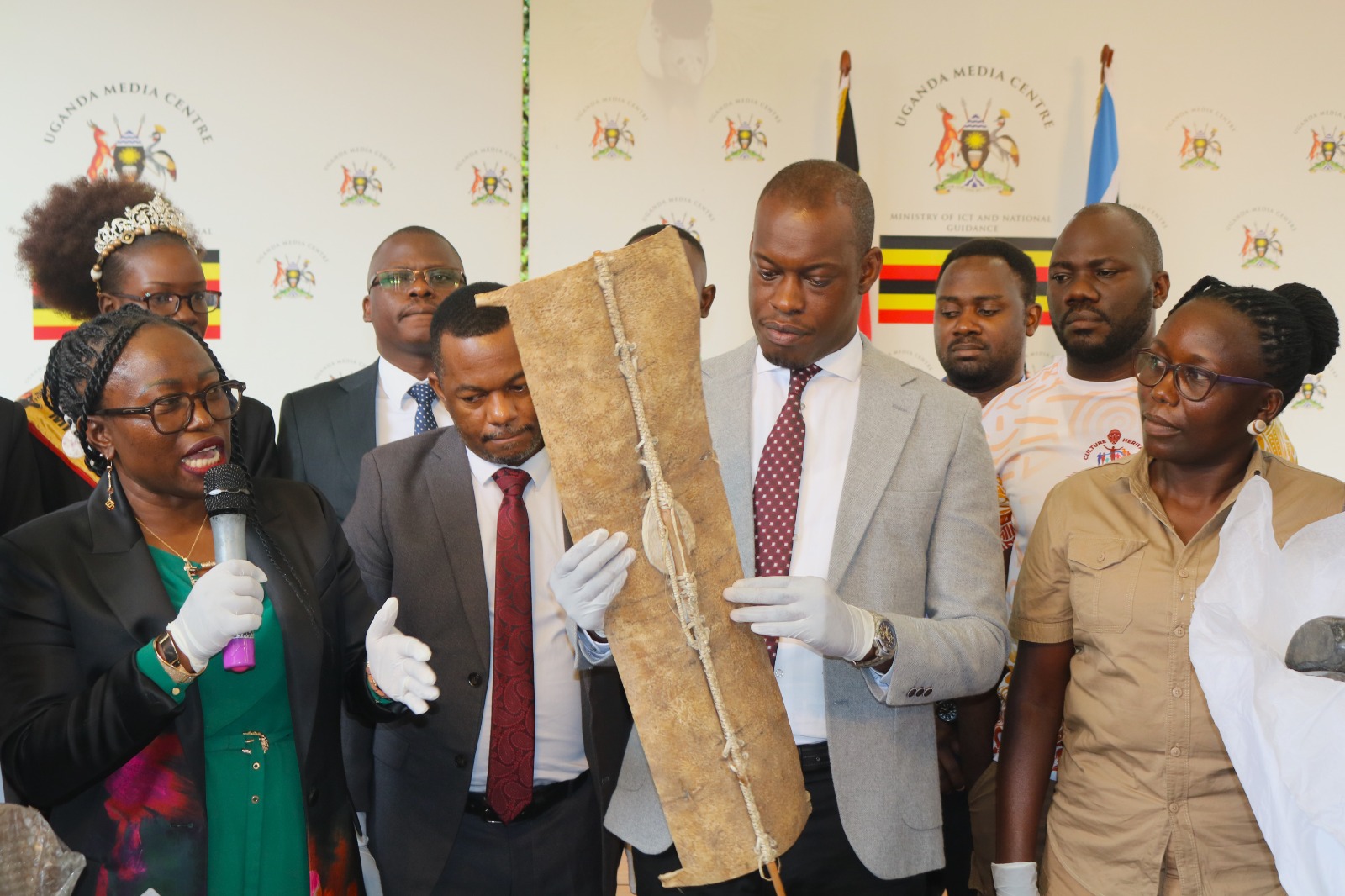
Uganda has taken a significant step in reclaiming its cultural identity with the official unveiling of repatriated artifacts from the Netherlands, marking a major milestone in the lead-up to International Museum Day 2026.
The unveiling, held at the Uganda Media Centre by the Ministry of Tourism, Wildlife and Antiquities, introduced the public to part of a 43-piece collection that had remained outside the country for over 50 years. The artifacts were originally collected between 1965 and 1967 by Dutch psychiatrist Cor Blok during his time at Butabika Hospital.
A Return Decades in the Making
 The Ministry indicated that Uganda has, through strategic international partnerships, successfully secured the return of several cultural objects within a relatively short period. These include earlier repatriations from the Cambridge Museum of Archaeology and Anthropology in the United Kingdom, as well as the Karamojong collection from Kenya.
The process of returning the Netherlands collection required an investment of approximately UGX 15 million, reflecting both logistical coordination and diplomatic engagement.
The artifacts are expected to undergo further research to determine their specific communities of origin, ensuring they are accurately contextualized and meaningfully reintegrated into Uganda’s cultural narrative.
Setting the Stage for International Museum Day 2026
The unveiling forms part of Uganda’s preparations to host International Museum Day 2026 in Jinja City on May 18. The global theme, “Museums: Uniting a Divided World,” and the national theme, “Museums as Bridges of Unity and Shared Heritage,” align with Uganda’s broader vision of using culture as a tool for unity, inclusion, and sustainable development.
The Ministry highlighted that museums are being positioned as safe and inclusive spaces that foster dialogue, reflection, and mutual understanding among communities. It was conveyed that museums are evolving beyond traditional roles to become dynamic platforms for learning and social cohesion.
The celebrations are further anchored on global development frameworks, including Sustainable Development Goal 8.9 on sustainable tourism, Goal 16 on peace and strong institutions, and Goal 17 on partnerships.
Cultural Diplomacy and Global Partnerships
The Ministry emphasized that collaboration with institutions in Europe and Africa has strengthened Uganda’s ability to preserve and recover its heritage. Through these partnerships, Uganda has positioned itself as an active participant in cultural diplomacy, promoting mutual understanding and shared heritage across borders.
The repatriation of artifacts from the Netherlands adds to Uganda’s growing record of successful returns, reinforcing the country’s commitment to restoring ownership of its cultural resources.
Museums Expanding Beyond Walls
Despite the closure of the Uganda Museum in 2024, the Department of Museums and Monuments recorded an increase in engagement, with visitor figures rising from 131,000 to approximately 260,000.
The Ministry indicated that efforts extended beyond the traditional museum space, including the development of regional museums across the country. These initiatives are aimed at decentralizing access to heritage and making cultural experiences more inclusive.
The Uganda Museum is expected to reopen before the next International Museum Day, with renewed anticipation around its upgraded facilities and programming.
Balancing Modern Development and Heritage Preservation
As Uganda continues to urbanize, preserving heritage remains a key challenge. The Ministry conveyed that modernization presents global pressures on cultural sites, requiring deliberate interventions to safeguard national heritage.
Through the Museums and Monuments Act, the government is working closely with urban authorities such as Kampala Capital City Authority to ensure that development projects respect heritage value. The approach emphasizes collaboration, allowing improvements while protecting historically significant structures.
It was clarified that buildings approved for demolition are those that do not hold national heritage significance, reflecting a selective and structured preservation strategy.
Heritage Sites as Anchors of National Unity
Uganda’s heritage preservation efforts extend beyond museums to include historical and memorial sites. Particular emphasis has been placed on the Luwero Triangle, recognized for its role in Uganda’s liberation history.
In collaboration with the Buganda Kingdom, 18 heritage sites have been developed in the region to preserve memory and promote unity.
Additional sites prioritized for development include Barlonyo Memorial Museum, the Kabalega-Mwanga site in Dokolo, and Fort Patiko. These spaces serve as platforms for remembrance, education, and cultural dialogue.
They complement iconic heritage landmarks such as the Kasubi Tombs, reinforcing Uganda’s position as a culturally rich tourism destination.
Tourism’s Growing Economic Contribution
The Ministry indicated that tourism remains a key driver of Uganda’s economy. In 2024, the sector generated approximately USD 1.3 billion, equivalent to about UGX 5 trillion, and supported more than 800,000 jobs.
Museums and heritage sites are increasingly being recognized as catalysts for tourism growth, offering opportunities to create employment, promote local culture, and stimulate innovation.
A series of activities leading up to International Museum Day 2026, including a national cultural heritage conference, heritage marathon, school competitions, and community outreach programs are expected to further enhance public engagement.
Engaging the Youth Through Digital Heritage
With Uganda’s population largely youthful, there is a growing emphasis on making heritage accessible and relevant to younger generations.
Digital platforms are expected to play a critical role in this transformation. By leveraging social media, digital storytelling, and virtual experiences, heritage institutions can extend their reach and engage wider audiences.
The repatriated artifacts present an opportunity to bridge tradition and innovation, transforming historical objects into engaging narratives that resonate with today’s digital generation.
A Story Reclaimed for Future Generations
The Ministry invited the public to view the repatriated artifacts during the International Museum Day celebrations in Jinja, describing the exhibition as an opportunity to reconnect with objects that have been absent from the country for decades.
Their return represents more than a symbolic gesture, it signals a broader shift in how Uganda values and presents its heritage.
As the country prepares for International Museum Day 2026, the unveiling stands as a powerful reminder that heritage is not just about the past. It is a living story, one that continues to evolve, inspire, and shape the identity of future generations.