
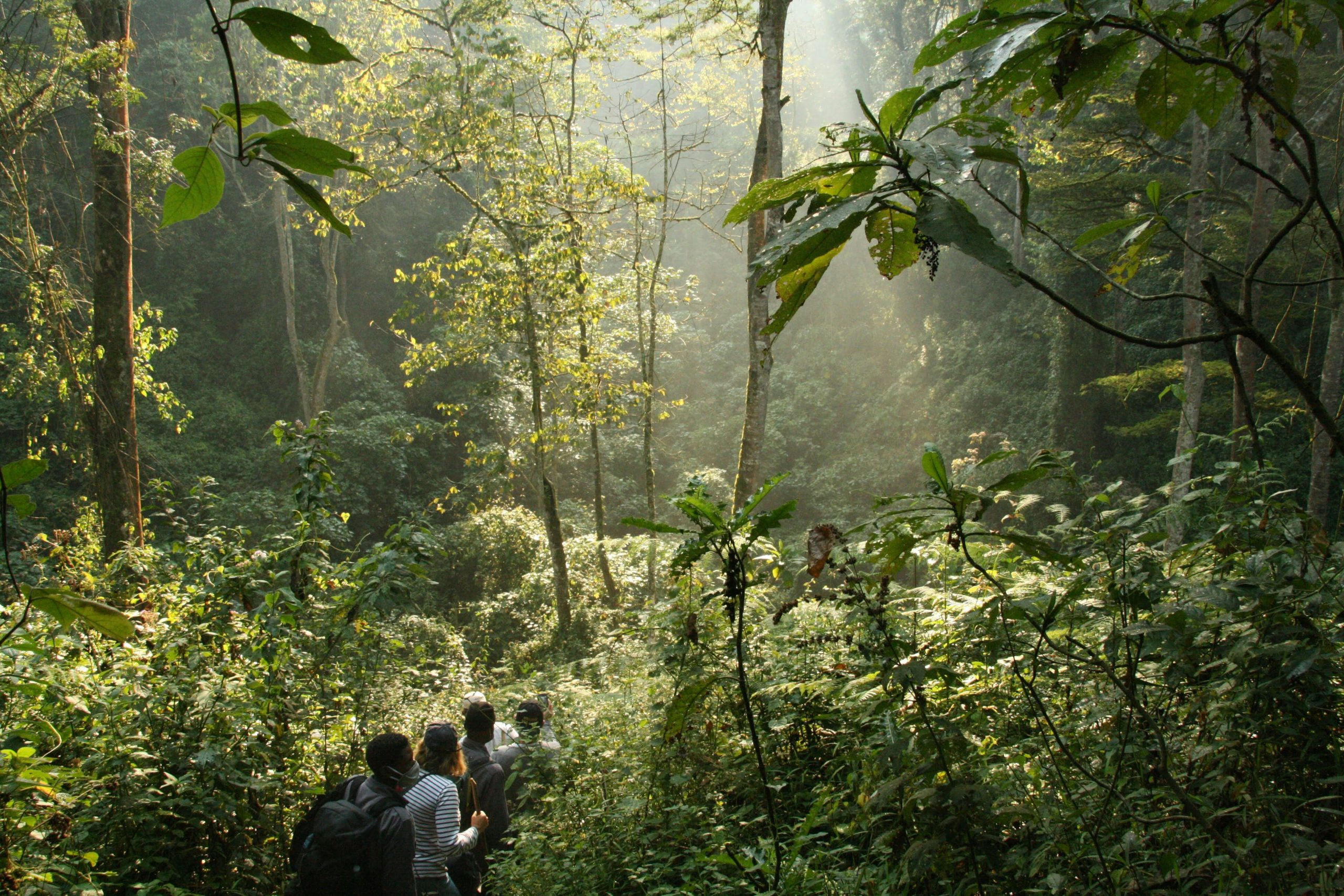
In the heart of southwestern Uganda, where the clouds wrap tightly around ancient forest canopies and the air smells of moss and morning mist, I had an encounter that changed the way I see the world.
The journey to Bwindi Impenetrable Forest was anything but easy. Dusty roads from Kabale town twisted through emerald hills and villages of rusted tin roofs. Children waved with wide eyes and brighter smiles, their laughter chasing our safari van like wind in a valley. I had come seeking gorillas, like many travelers do, armed with binoculars, a small camera, and an appetite for adventure. What I found instead was a deep, personal call to conservation.
We arrived at Buhoma, one of the main entry points to the park, just before dusk. The forest loomed, quiet and knowing, like an elder who had seen too much to speak often. Our guide, Jackson, met us with a handshake as firm as the handshake of the earth itself. “Tomorrow,” he said, “we go find your cousins.”
The phrase lingered in my head. My cousins.
Morning came wrapped in mist and mystery. We began our trek just after sunrise, accompanied by rangers and porters. Our group was silent at first, crunching through layers of leaves and damp soil, hearts pounding with a mix of anticipation and altitude.
As we climbed higher, Jackson whispered stories about the forest. “Bwindi means ‘darkness,’” he said. “Because of how thick the forest is. But inside that darkness, there is life that glows.”
The first sound we heard was a distant rustle, followed by a sharp bark. “That’s them,” Jackson smiled. “They know we’re coming.” He motioned for silence. We crept forward, breath shallow, cameras forgotten.
And then they appeared.
A silverback sat like a throne of muscle and memory. Around him, females tended to infants, younger ones playfully rolling in the underbrush. One curious juvenile approached us his eyes bright with wonder, mine brimming with tears. It wasn’t just the awe of seeing them; it was the way they looked back at us.
Not afraid. Not aggressive. Just… aware. In that moment, something shifted in me.
The forest didn’t just shelter these great apes it echoed with their presence. Every tree branch and fern seemed to lean in with purpose. The gorillas weren’t separate from it; they were it.
And we, the visitors, were the guests not just of the park but of a far more ancient and sacred relationship between land, life, and legacy.
Later, back at the lodge, Jackson shared stories of poaching in the 1980s and 1990s, when gorilla numbers had plummeted. “We nearly lost them,” he said quietly. “But the community decided we wanted our children to grow up knowing the gorillas—not just from pictures, but from the forest.”
It was locals, not just international organizations, who had become the guardians of Bwindi. Former poachers were now rangers. Women in the villages wove gorilla-themed crafts and managed homestays. A percentage of every permit fee went to surrounding communities supporting schools, clinics, clean water. Conservation wasn’t just about saving animals. It was about giving people a reason to save them.
That night, I couldn’t sleep. The forest called again this time not to witness, but to act.
When I returned home, the real journey began. I started by writing about my experience, not just the gorillas, but the interconnectedness of everything: how our choices as travelers can preserve or destroy. I spoke at schools. I volunteered for local conservation education programs. I stopped buying products that fueled deforestation. I began donating to initiatives that empowered communities around critical ecosystems.
The encounter in Bwindi didn’t just inspire me to care it made me realize that conservation is not a distant idea. It’s personal. It’s political. It’s present in every decision we make what we eat, where we travel, how we speak, and what we choose to protect when no one is watching.
Conservation doesn’t begin with a billboard or a brochure. It begins with an encounter. A stare from a creature that shouldn’t know your name but somehow does. The silence of a forest that tells a story without a single word. The realization that nature is not just a backdrop to our adventures it is the very stage on which life unfolds.
Bwindi whispered its truth into me: that the future of our planet isn’t something we inherit it’s something we earn. Through respect. Through action. Through love.
As I write this, the scent of that forest still clings to my memory like morning fog to a hillside. I can still hear the rustle of leaves, the crunch of my boots, and the gentle, unspoken request from a silverback’s eyes:
“Remember us. Protect this. Tell others.” And so I do.
WRITTEN BY CHOZEN IRENE AKELLOT