
Long gangly shadows stretched across two red-earth courtyards where in one a Nubian woman kneads dough for kisra bread, their hands move in patterns unchanged for generations, pressing flour into perfect circles that will crisp over open fires. In another yard, the day’s last light catches the intricate patterns of a young girl’s henna tattoo, a design her grandmother learned from her grandmother. Nearby, a university student records an elder singing a wedding song nearly lost to time. In this moment, the past and future hold hands. This is Bombo’s living museum, not glass-encased artifacts, but the breathing, evolving legacy of a people determined to preserve their identity. Unlike cultures lost to war, Nubian Culture faces a more insidious threat, the slow death of indifference. The fading Ki-Nubi language, the vanishing way of life, holds the soul of a people, and its fragile heartbeat grows fainter each year.
Bombo located along the main circuit to Uganda’s biggest and oldest National Park stands as the last stronghold of Uganda’s Nubian heritage, where the living remnants of a proud culture cling stubbornly to existence against the relentless tide of modernity. The Nubians ,descendants of
Dr Emin Pasha’s Sudanese soldiers who settled in Uganda under British colonial rule, have woven their traditions into Uganda’s cultural tapestry over generations. Yet today, their unique identity faces extinction, not through violence or forced assimilation, but through the quiet erosion of time and neglect.
The story of Nubians in Uganda began with colonial military drafts but blossomed into something far more profound. These descendants of Sudanese warriors brought with them more than just military discipline , they carried an entire cultural ecosystem. The geometric precision of their basket weaving incorporated local plant fibers while maintaining patterns found in ancient Nubian tombs. Even their cuisine became a delicious dialectic between Sudanese flavors, Ugandan ingredients as well as Islamic dietaries which emphasize halal(Islamic laws).
The Ki-Nubi language forms the heartbeat of this culture. This unique creole, blending Arabic, Swahili, and local languages creates a language as unique as the culture it expresses, and its rhythm carries the entire history of the Nubian journey.When elders speak it, one hears the camel caravans of Sudan, the Bombo military barracks of colonial Uganda, and the vibrant markets of modern Bombo.
The Nubian crafts are not just objects but strokes of resilience that once defined Nubian artistry, intricate geometric patterns of true craft gems; the Kuta(food cover), Tabaga, and biris(mats) now struggle to find new generations of artisans. Each piece holds a Nubian woman’s livelihood, a child’s inheritance, and a culture’s defiance against time. Master craftsmen, often women with fingers fluent in tradition watch helplessly as their life’s work becomes museum pieces rather than living traditions. Even the vibrant Nubian festivals that once brought communities together now occur with diminishing visibility, frequency, and participation.

Courtesy of a Nubian Kuta(food cover)
Women still prepare kisra bread using methods unchanged for generations, their hands moving in the same patterns as their great-grandmothers’. But still, fast-foods have replaced time-honored meals; Mullah(meat stew), Gurusa(thick pancake), kisra(Flatbread), pilau and Bamia(okra stew).These Nubian signature dishes are often communal with dishes served on large platters for sharing reflecting their cultural emphasis on hospitality.

Courtesy of Gurusa(thick pancake)
The elaborate henna designs that adorn brides’ hands preserve symbolic motifs dating back to Nubia’s ancient kingdoms. The rhythm of the doluka drum, its persistent beat, a metaphor for cultural survival; sometimes faint, sometimes strong, but never completely silent. The beautiful smiles and enchanting laughter of the Nubian women dazzling in Gurbaba(cultural attire) and Suk-suk(beads), true jewelry queens wiggle at the sound of doluka(traditional dance) during Selas(introduction) and Nikkas(tying the knot), revealing their true cultural identity.
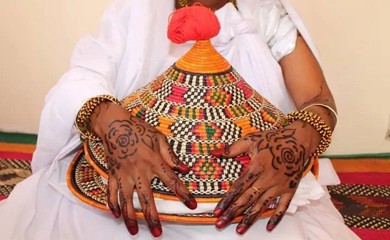
Courtesy of a Nubian bride with Henna tattoo on a Nikka ceremony(tying the knot)
As the mosques hum, heads bow five times a day in one rhythm. Islam among the Nubians is not just a religion but a cultural relic. Islam arrived in Uganda through the footsteps of Arab traders in the 19th Century, but its first permanent home was in Bombo, a military garrison. Masjid Noor, Uganda’s first mosque, visited by King Faisal from the Royal Kingdom of Saudi Arabia in 1972 still stands; unknown, abandoned, faded and an aging minaret different from those elsewhere in East Africa bears witness to a quiet disappearance.
Each passing year claims more of the culture’s living repositories. The elders who remember the old songs, the traditional healing practices, the folktales that encode generations of wisdom.
These human libraries disappear one by one, taking irreplaceable knowledge with them. Photographs and recordings cannot capture the full richness of oral traditions that require living transmission from teacher to student and parent to child.

Courtesy of a Nubian artisan making Nubian artifacts
Bombo’s struggle offers lessons for endangered cultures worldwide because cultural conservation and preservation requires more than museums, it demands living spaces where traditions can evolve while retaining their essence and authenticity. The greater threat lies in interrupted transmission, the broken chain between generations that leaves cultural knowledge
stranded in the past. When a master blacksmith dies without apprentices, an entire artistic tradition dies with him. When children no longer learn the proper preparation of bamia stew, a culinary heritage evaporates. There are fewer master artisans, and few elders know the complete repertoire of ceremonial wedding songs. Ki-nubi appears in Uganda’s endangered languages.
The Nubian legacy stands at a crossroads. Without intervention, Bombo may become just another Ugandan town, its unique cultural fingerprint smoothed away by globalization’s relentless erasure. But with concerted effort, it could blossom into a model of living heritage conservation, where tradition and progress dance in harmony we can ensure that future generations will still hear the doluka rhythm, taste the kisra’s earthy warmth, and speak the poetic words of Ki-Nubi.
Bombo’s call echoes across Uganda and beyond , a reminder that every culture lost diminishes us all. In preserving the Nubian heritage, we safeguard not just their identity, but a vital piece of humanity’s diverse mosaic. The encounter between past and present happening today in Bombo’s dusty streets may well determine whether a unique culture survives or vanishes forever into silence. The preservation of Nubian culture isn’t about nostalgia, it’s about maintaining the vibrant diversity that makes our world rich. Each unique language, cuisine, and art form represents a different way of being human, a distinct solution to life’s challenges. When we lose one, we all grow poorer.
Bombo’s call isn’t just to the Nubian communities of Uganda, but to all of us who value cultural richness. It asks: What traditions are we allowing to slip away in our communities? What priceless knowledge disappears daily with our elders? And most importantly, what are we doing about it? In Bombo’s dusty streets, a daughter of the soil writes the next chapter of its remarkable story, proving that heritage isn’t just what we inherit, but what we dare to reinvent.