
It was early morning, the mist began to rise over the Kazinga channel and the first golden rays of sunlight filtered through the tall elephant grass. I stood quietly at the edge of the Mweya Peninsula

, my camera dangling from my neck but for once, I was not in a hurry to capture the moment. I was simply present awed by the serene beauty that surrounded me, quiet power of nature unfolding in its purist form. I had come to Queen Elizabeth National park expecting a safari adventure. What I did not anticipate was how profoundly I would encounter conservation-not as a practice but as a living and breathing force that shapes lives and landscapes.
Nestled in Western Uganda, Queen Elizabeth National park is more than a tourist attraction; it is a conservation story in motion. Spanning savannahs, crater lakes, wetlands and forests, the park is a home to over 95 species of mammals and 600 bird species. However, beneath the surface of its postcard beauty lies a daily struggle-a delicate balancing act between biodiversity conservation, tourism and the lives of communities that border its fringes.
My journey began with a game drive in kasenyi plains, the morning was crisp and
the tracks were fresh from the night’s wildlife activity. Within minutes, we
encountered a herd of Uganda kobs;
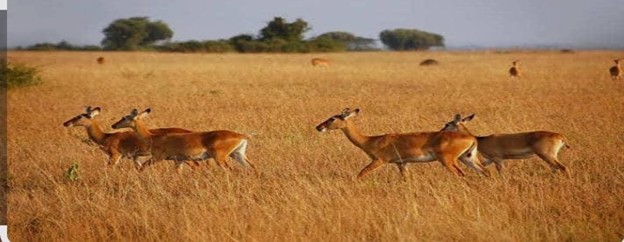
their ears twitching at every sound in the distance, a solitary lioness watched silently, her body taut with hunger and patience. Our guide, Robert spoke in hushed tones about how the park’s lion population especially the famous tree climbing lions of Ishasha faced increasing population pressure from habitat loss and human wildlife conflicts.
“Every lion you see here is a conservation victory,” he said. “They are hunted in
other places, but here they are protected, monitored, studied and respected.
Robert introduced us to the Uganda Carnivore program (UCP), a conservation initiative based within the park that works to protect large carnivores such as lions, leopards and hyenas. The program uses radio callers, community education and research to track and safe guard these apex predators. Later we passed a discreet signpost marking the UCP field station. It struck me then that conservation wasn’t just happening in labs or government offices, it was happening here in the heart of the wild, led by rangers, scientists and local people whose lives were interwoven with the fate of these animals.
One of the most moving experiences came during boat cruise along the Kazinga channel. Hippos grunted lazily in the shallows while buffaloes
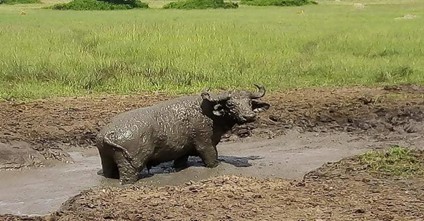
wallowed in the mud and
Water birds dotted the shoreline like ornaments. Our guide pointed out the importance of the channel as a critical ecosystem for aquatic life and lifeline for larger mammals especially during the dry season. The channel also serves as a vital research site for conservationists studying water quality, fish populations, and the impact of tourism on wildlife behavior.
What fascinated me most was the unspoken harmony. Animals and humans coexisted in a complex but functioning system. Fishermen cast nets from wooden canoes not far from basking crocodiles. In the nearby villages, local women sold crafts made from recycled papers and natural dyes, an initiative supported by the park to reduce dependence on poaching and charcoal burning.
A stop in the village of Kikorongo revealed another layer of this story. Here, I met Grace, a mother of four and a member of the Kikorongo Women Community Initiative. She welcomed us with a shy smile and explained how the group uses traditional storytelling, music and craft making to educate both locals and tourists about conservation.
“Before many people thought wild animals were only a problem,” she said. “Now
we see they bring visitors, and the visitors help our schools, health centers.
Conservation is not about animals it is about our future.”
Her words echoed in my minds as we made our way to the southern Ishasha section known for its elusive tree-climbing lions. We waited nearly two hours before spotting onemajestic male lion.
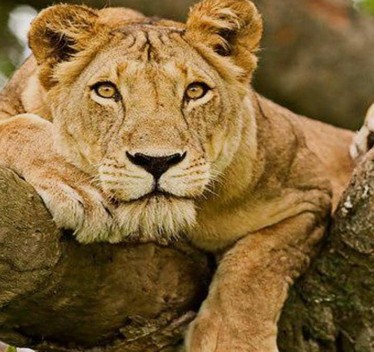
It was a surreal sight, one that
no documentary could truly prepare you for. However, as I watched him doze beneath the sun, I also noticed something else; the burned edge of a nearby bush, evidence of a controlled fire-a conservation tool used by park authorities to manage invasive species and restore grasslands.
It was yet another reminder that conservation is not passive; it requires strategy, science and constant adaptation. In Queen Elizabeth National Park, it also requires cooperation between the Uganda Wildlife Authority (UWA), NGOs, researchers and communities.
In the afternoon, I spoke to Charles a park ranger who has worked in the area for over a decade. He shared stories of arrests, patrols and even personal threats from poachers.
“But I do it for children,” he said, gesturing to the hills in the distance. “I want them to grow up and still see elephants walk across the plains.”
I was struck again: conservation is not just about protecting wildlife, it is about preserving possibility. The possibility for a leopard’s paw print to remain etched in the dust. For a child to grow up hearing the trumpet of an elephant. For tourists like me to encounter beauty and be transformed by it.
As my trip ended, I realized that my experience in Queen Elizabeth National Park had reshaped how I viewed tourism. It was not just about sightseeing; it was about
bearing witness to a struggle, resilience and the unbreakable connection between people and nature.
Conservation here is not perfect. Challenges like illegal grazing, charcoal burning and population growth persist. However, there is also hope in the vigilance of rangers, the curiosity of visitors, and the determination of communities who have come to see wildlife not as a threat, but as a partner in prosperity.
I left Queen Elizabeth National Park with more than just photos but I carried stories, Grace’s smile, Robert’s passion, Charles’ courage and the silent strength of a lion in a fig tree. These were the real souvenirs. In addition, they continue to remind me that every encounter with conservation is also an initiation to protect, learn and believe in the power of coexistence.