

Kampala woke up today, still buzzing from the excitement that unfolded yesterday, 14th November 2025, at Sheraton Hotel. Where Uganda Tourism Board officially launched the Pearl of Africa Tourism Expo 2026. The announcement marked the beginning of a new chapter as the industry set its gaze on the coming edition scheduled for 21st–23rd May 2026.
With stakeholders drawn from across Uganda’s tourism ecosystem, the unveiling of the theme set the tone for what the Pearl of Africa Tourism Expo 2026 aims to represent. As the conversations deepened and the vision for the next Expo became clearer. It was evident that the Pearl of Africa Tourism Expo 2026 would not only celebrate Uganda’s identity but also reinforce the country’s standing on the global stage.
The Panel Discussion, Insights and Industry Realities
The day began with a panel discussion that brought together key sector players, each addressing the evolving demands of modern tourism and the challenges that must be tackled in preparation for the coming year. Representatives from Uganda Wildlife Authority, Uganda Airlines, the Association of Uganda Tour Operators, and the private sector. Collectively highlighted the shifts taking place in destination marketing, visitor connectivity, product development, and technological transformation.
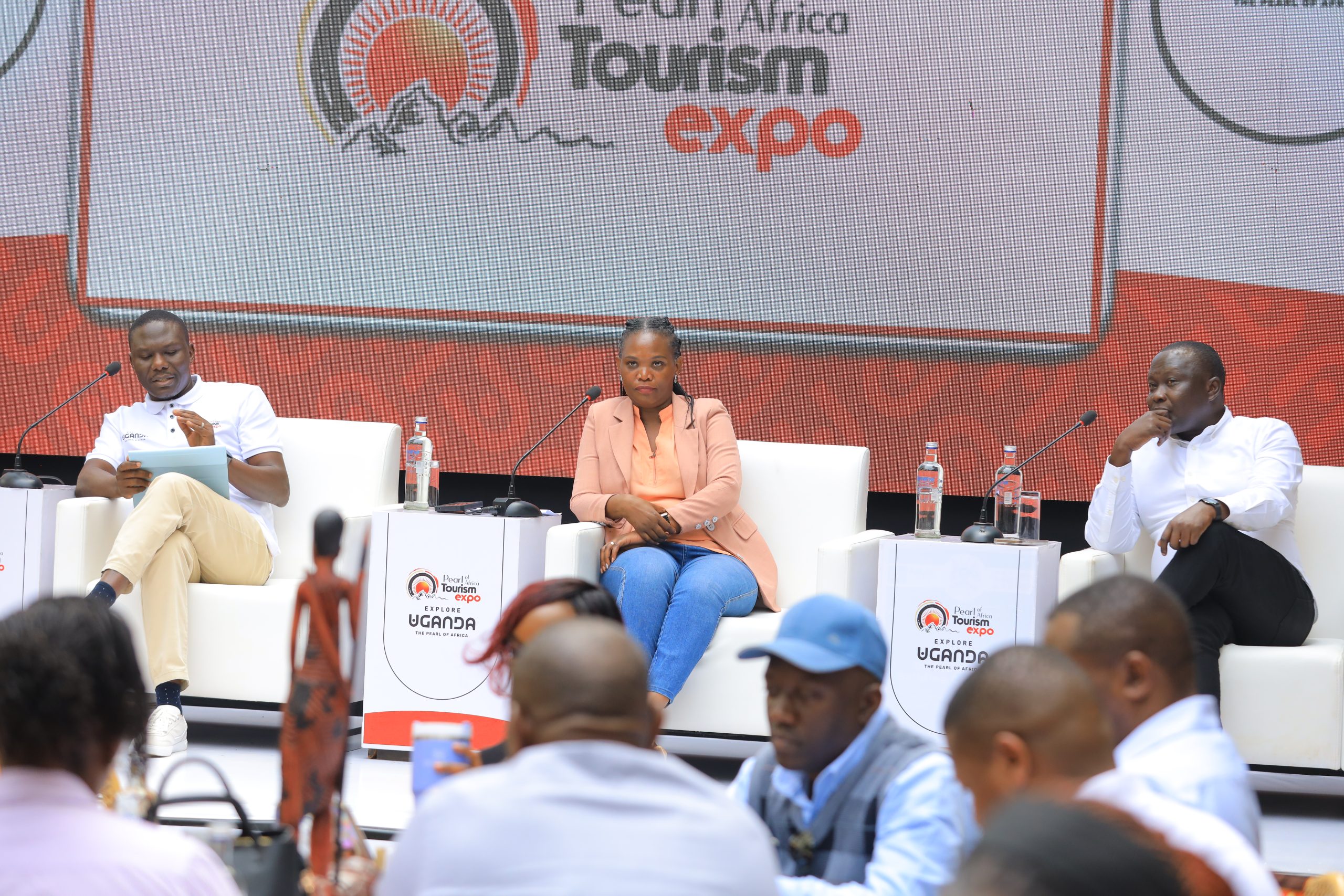
The private sector’s agenda centred strongly on increasing digital presence as a way of improving efficiency and reducing operational barriers. They explained that with wider adoption of technology, there would naturally be fewer human-led processes, but the improved efficiency would ultimately enhance business operations and service delivery across the tourism value chain.
Gaps in Destination Marketing and Global Visibility
Attention was also drawn to the gaps in destination marketing. Although Uganda Airlines has opened direct routes to key international cities such as Abuja, Lagos, London, and Mumbai. The industry noted that Uganda had not been adequately marketed in many of those destinations.
Stakeholders emphasised the need to maximize the visibility of Destination Uganda in all cities connected to the national carrier. Arguing that once a market is opened, tourism must follow quickly and deliberately. They agreed that every destination Uganda flies to is an opportunity and that the impact of tapping into those markets could be immense for the sector.
Connectivity and Infrastructure, The Backbone of Tourism
Connectivity remained a central talking point. Stakeholders acknowledged that Uganda’s tourism experience depends heavily on well-functioning systems, including road networks, communication infrastructure, mobile networks, and transport services. While progress has been made, especially on major road upgrades and the increasing operations of Uganda Airlines. The panel stressed that more work is needed to give visitors a seamless and satisfying experience. This included concerns over the cost of domestic flights.
The private sector expressed the need for structured engagements with airlines to explore ways of making local connections more affordable. Especially for travellers exploring multiple attractions within Uganda. Uganda Wildlife Authority elaborated on its ongoing collaborations with national entities such as NITA-Uganda, Uganda National Roads Authority and telecom companies.
To improve connectivity within protected areas. They noted that technology and well-developed networks are essential for tourism promotion, conservation monitoring, and visitor safety, but the private sector would need to keep pushing to ensure that these improvements are prioritized.
Conservation at the Center of Tourism
UWA also emphasized that conservation remained at the heart of tourism and that tour operators had been exemplary in respecting conservation guidelines. Especially in gorilla tourism. They pointed out that half of Uganda’s gorilla population remains unhabituated to protect the species in case of disease outbreaks or emergencies. The insistence on controlled visitor numbers, regulated viewing distances, and strict adherence to conservation rules has helped maintain the integrity of gorilla families and ensure long-term sustainability.
The panel further highlighted the role of local communities in conservation. It was explained that communities living around national parks remain essential partners in protecting wildlife and forests. Through the Revenue Sharing Fund, where 20% of park entrance fees are returned to neighbouring communities, many households have witnessed direct benefits from conservation efforts.
This has encouraged them to safeguard wildlife instead of harming it. Although human-wildlife conflicts still occur in some areas, continued dialogue and collaborative problem-solving have helped mitigate these tensions. On their part, tour operators reiterated their commitment to responsible tourism, emphasizing their support for local communities through accommodation, entertainment, and craft purchases, all while upholding UWA’s conservation policies even during peak tourism seasons.
Keynote Addresses, Vision and Strategy
Once the panel discussion came to an end, the stage was set for the keynote speeches. Beginning with an address from Juliana Kagwa, the CEO of the Uganda Tourism Board. She began by celebrating Uganda’s major milestone as Bwindi Impenetrable National Park was recently ranked the third best adventure destination in the world, an achievement that has amplified Uganda’s visibility in global tourism circles.
She also highlighted that investment in the tourism sector had grown by an impressive 250% in the current financial year. Signalling renewed confidence in the country’s tourism potential. With Uganda Airlines expanding its network through more direct international routes, Juliana noted that the future of tourism growth looked more promising and more accessible than ever before.
Unveiling the 2026 POATE Theme, Wanderlust
Juliana then shifted into what many considered the most pivotal moment of the day. The unveiling of the 2026 Pearl of Africa Tourism Expo theme, Wanderlust. She explained that the theme captured Uganda’s essence in its truest form. Wanderlust, she said, represented culture, heritage, provenance, people, and food. It symbolized a 360° experience that visitors could not find anywhere else in the world. The focus for 2026 would be deep immersion. Not superficial displays or performances, but meaningful encounters with Uganda’s identity.
Juliana stressed that the industry was moving away from traditional exhibition formats that often felt like beauty pageants. Where countries competed through music, costumes, and glamour. For 2026, the priority would be commerce. Uganda would not merely showcase products, it would sell them. Exhibitors would be encouraged to bring booking machines, systems, and real packages to the Expo.
Hosted buyers and visitors would be immersed in Uganda and given the opportunity to book, reserve, purchase, and experience the country in real time. Uganda, she insisted, would not walk away from the tenth edition of POATE empty-handed. The intention was to secure business, contracts, reservations, and tangible economic value.
Juliana also emphasized the urgency of early preparation. She explained that hosted buyers are highly sought-after professionals. Whose schedules must be secured months in advance. Engaging them late results in low-tier attendance, which Uganda was not willing to settle for. Therefore, UTB began preparations early to ensure high-ranking global tourism professionals, speakers, and buyers participate in the 2026 Expo.
New Additions and Strategic Partnerships
She also revealed new concessions from Speke Resort Munyonyo, including an extended setup and breakdown period and, for the first time, a dedicated culinary exhibition open to UBRS-certified businesses. This addition would allow hosted buyers and visitors to experience authentic Ugandan cuisine in a curated environment.
The Vice President of the Uganda Tourism Association, Mr. Isa, followed with a message emphasizing the purpose of POATE. He noted that the Expo was designed to turn curiosity into contracts and interest into meaningful market share.
Under UTA, he reaffirmed the sector’s commitment to building capacity, elevating service quality, strengthening professional standards, and ensuring that every visitor experienced excellence at every touchpoint. He emphasized that POATE 2026 would not only inspire the world but solidify Uganda’s position as a high-value tourism destination. The Chairperson of the Uganda Tourism Board,
Pearl Kakooza, the Board Chairperson at Uganda Tourism Board. Delivered her remarks next, highlighting Uganda’s agricultural heritage through a unique focus on coffee. She reminded stakeholders that Uganda is the birthplace of Robusta coffee, a fact that should be amplified globally as a point of national pride.
She also noted that Uganda is home to other rare coffee varieties such as Liberica. Which grows wild and holds unique characteristics that deserve more research. She encouraged the sector to embrace these unique stories, arguing that they form part of Uganda’s authentic identity that should be showcased on international platforms.
The Minister’s Call for Growth and National Progress
The event concluded with an address from the Minister of Tourism, Wildlife and Antiquities, Hon. Tom Butime. Who emphasized that tourism growth is anchored in deliberate investment, infrastructure development, and a unified national vision. He stated that the country aimed to grow tourist arrivals to between five and seven million annually, a shift that would transform businesses, strengthen livelihoods, and accelerate national progress.
He pointed out that tourism-focused road upgrades, environmental protection, and sustainable development. Remained top priorities as Uganda positioned itself among the world’s leading destinations. He reaffirmed Uganda’s commitment to meeting global tourism standards and emphasized that the recent recognition as the third best adventure destination in the world was only the beginning of Uganda’s rise. He closed the day by officially launching preparations for the Pearl of Africa Tourism Expo 2026.
Conclusion
The atmosphere throughout the event reflected a sector ready for transformation. With Wanderlust as its guiding theme, Uganda steps into 2026 with a renewed purpose. To immerse the world in everything that makes the Pearl of Africa unforgettable. And to ensure that every moment, every experience, and every encounter counts not only emotionally, but economically.