
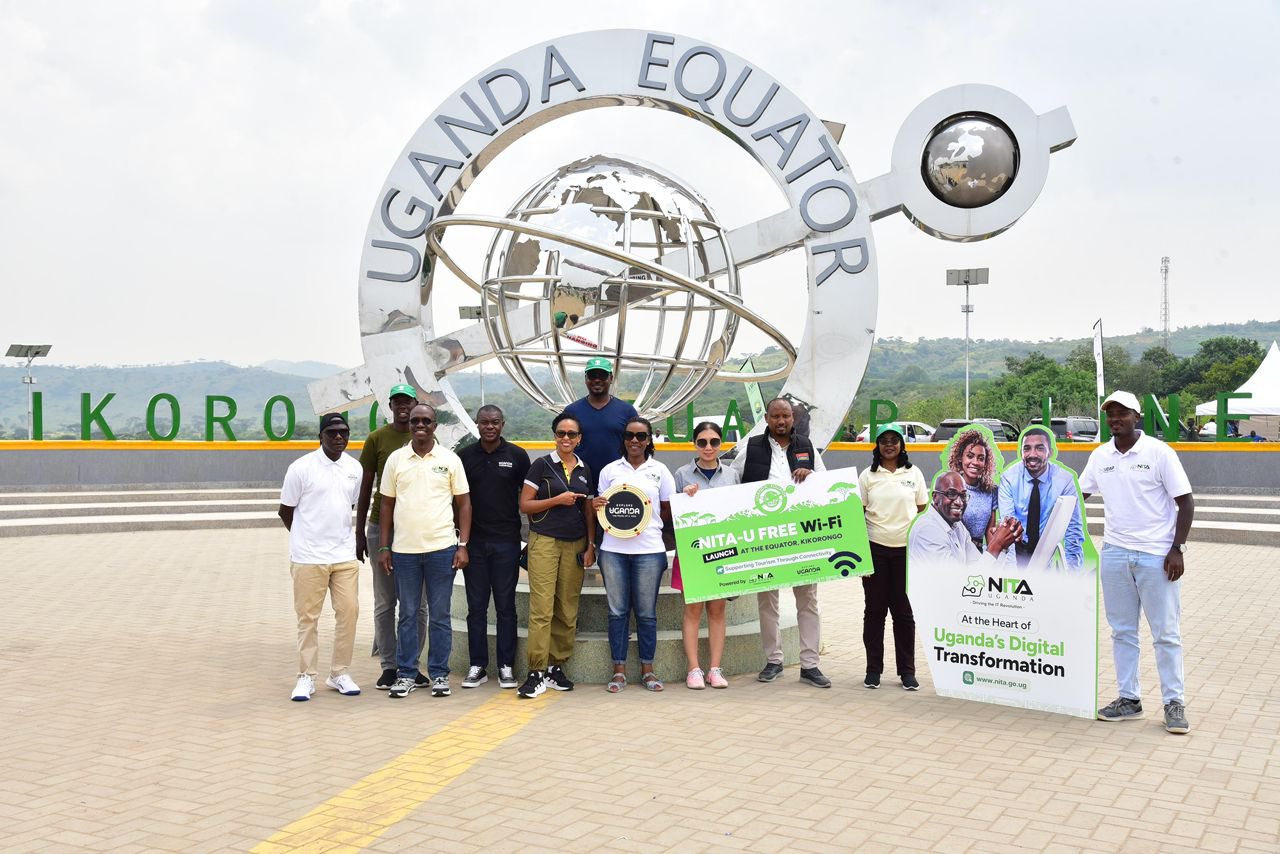
Tourists heading to western Uganda now have more than just breathtaking views and iconic landmarks to look forward to. The Kikorongo Equator Monument, an essential stop along the Kasese Fort Portal Road has become the latest site to offer free public Wi-Fi, thanks to a collaborative initiative by the Government of Uganda, through the National Information Technology Authority – Uganda (NITA-U), in partnership with the Uganda Tourism Board (UTB) and Uganda Wildlife Authority (UWA).
This development includes three locations: the Kikorongo Equator Monument itself, Kasese Main Street, and the Stanley, Margherita, and Rwenzori Roads. These access points are designed to serve not only tourists and residents but also participants in the upcoming Tusker Lite Rwenzori Marathon, one of East Africa’s most celebrated sports tourism events.
With fast and reliable internet now available in these key areas, officials expect significant improvements in live event coverage, visitor engagement, and access to online services for surrounding communities. The launch precedes the 4th edition of the internationally recognized Rwenzori Marathon, drawing thousands of athletes and spectators from Uganda, the region, and beyond.
Hon. Godfrey Baluku Kabbyanga, State Minister for National Guidance, emphasized the wider social impact: “By bringing free internet to Kikorongo, we bridge the digital divide while enhancing tourism, sports, and economic opportunities for the local community.”
From a technical standpoint, the initiative reflects Uganda’s growing investment in digital infrastructure that supports travel and cultural experiences. Richard Obita, Director of Technical Services at NITA-U, speaking on behalf of the Executive Director, described the launch as a foundation for a smarter tourism model: “This launch marks our first of many steps toward smart tourism, where connectivity meets culture, sports, and exploration. We are proud to support the tourism sector and the Tusker Lite Rwenzori Marathon with infrastructure that enables live streaming, real-time updates, and a richer experience for runners and spectators alike.”
For the Uganda Tourism Board, this rollout aligns with a broader strategy of promoting Uganda as a connected, accessible, and digitally visible destination. Juliana Kaggwa, CEO of UTB, noted:“Tourism today is digital-first. This initiative enhances the visitor journey and positions Uganda as a connected destination where experiences can be shared globally in real time.”
Importantly, the project also supports conservation tourism, a growing segment that relies on storytelling and public engagement to inspire environmental stewardship. Eric Morris Enyel, Chief Warden of Queen Elizabeth National Park, commented: “Connectivity adds a new layer to conservation tourism. Real-time sharing and learning deepen appreciation for our natural heritage.”
The synergy between sports and tourism is also amplified by the timing. Amos Wekesa, Team Leader of the Tusker Lite Rwenzori Marathon, emphasized the visibility this technology brings to Uganda’s landscapes and people: “The Tusker Lite Rwenzori Marathon is about more than running; it’s about showcasing Uganda’s beauty to the world. With free Wi-Fi, participants can share their journey instantly, inspiring more people to experience the magic of the Rwenzoris.”
As the marathon approaches, the timing of this digital milestone is no coincidence. Uganda’s broader vision of social and economic transformation is increasingly grounded in technological inclusion. By weaving connectivity into the fabric of tourism, conservation, sports, and community life, the country is not just improving visitor experience, it’s enabling broader participation in the digital economy.
By Nakasanje Jannat